
TL;DR: Generative Engine Optimization (GEO) is the new discipline of optimizing your website and content so AI platforms like ChatGPT, Perplexity, and Google AI Overviews cite, recommend, and feature your brand not just rank it. This guide covers what GEO is, how it differs from traditional SEO, the full pros and cons, and actionable steps you can take today.
Introduction: The Biggest Shift in Search Since Google Was Born
Search has changed more in the last 18 months than in the previous decade combined.
If you run a small business or work with a professional SEO company, you’ve probably noticed something strange: pages that once ranked well are now competing with AI-generated summaries that appear before any organic result. Users are getting answers without clicking. And tools like ChatGPT and Perplexity are replacing the traditional search bar for millions of queries every day.
This is not a trend to “wait and see.” This is a fundamental restructuring of how the internet surfaces information and it has a name: Generative Engine Optimization, or GEO.
At DigitalBranches.com, our website optimization services are already incorporating GEO into every client strategy. In this pillar guide, we break down everything you need to know — the data, the strategy, the pros, the cons, and the action plan.
📊 Data Point: AI-referred sessions jumped 527% year-over-year in the first half of 2025. Source: Previsible 2025 AI Traffic Report via Frase.io
1. What Is Generative Engine Optimization (GEO)?
Generative Engine Optimization (GEO) is the practice of structuring your content, brand presence, and authority signals so that AI platforms including Google AI Overviews, ChatGPT, Perplexity, Gemini, and Bing Copilot cite, reference, and recommend your brand when users ask questions relevant to your business.
The term was first defined in academic research by Aggarwal et al. at Princeton, Georgia Tech, and IIT Delhi in 2023. By 2025, it entered mainstream marketing vocabulary. By 2026, most enterprise teams have a GEO initiative but most small and mid-size businesses have not started yet. That gap is your opportunity.
Here’s the key distinction: Traditional SEO optimizes for a ranked list of blue links. GEO optimizes for inclusion inside AI-generated answers where your brand’s data, insight, or expertise becomes part of the response itself.
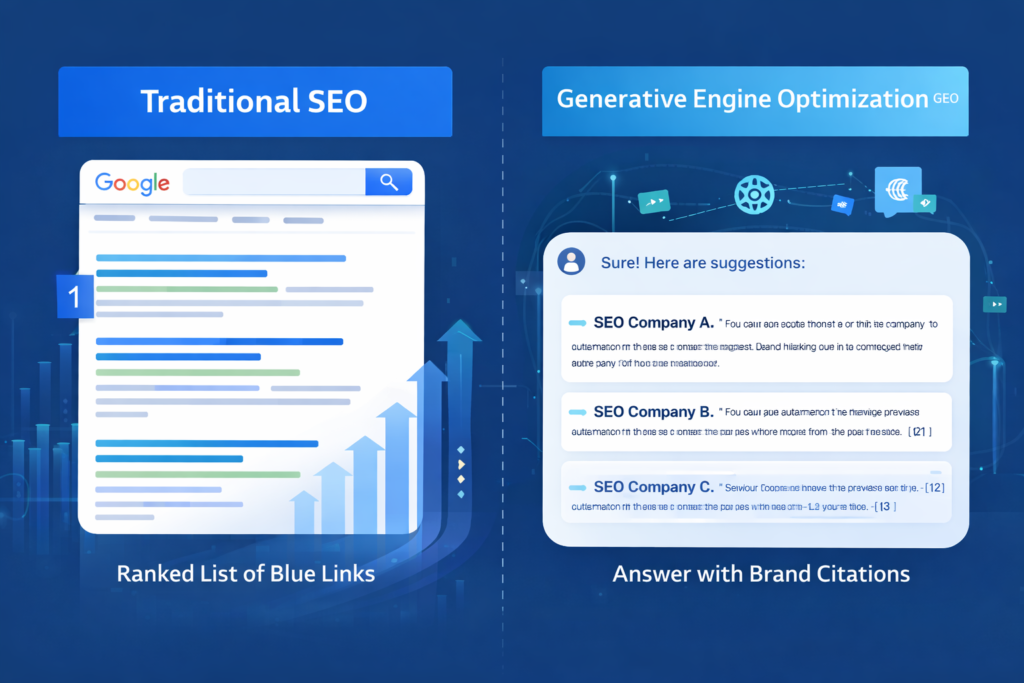
SEO vs AEO vs GEO — What’s the Difference?
These three terms are often used interchangeably, but they are distinct layers of the same visibility strategy:
- SEO (Search Engine Optimization) — Optimizing to rank in Google’s traditional blue-link results. Still the foundation. Google processes roughly 14 billion searches daily.
- AEO (Answer Engine Optimization) — Optimizing for featured snippets, direct answer boxes, and “People Also Ask.” Structured to answer specific questions concisely.
- GEO (Generative Engine Optimization) — Optimizing for AI-generated responses across ChatGPT, Perplexity, Google AI Overviews, and Gemini. The newest and fastest-growing layer.
💡 Key Insight: These are not competing strategies — they are layers. Start with SEO as your foundation, layer in AEO for featured snippets, and add GEO to capture AI-generated visibility. All three together is what DigitalBranches.com calls a full-spectrum website optimization strategy.
According to Semrush’s 2026 GEO analysis, you need both traditional SEO metrics AND AI visibility metrics to understand your full organic search presence in 2026. Tracking AI citation share, citation sentiment, and zero-click displacement are now the core KPIs of a modern SEO client report.
📊 Data Point: In 2026, AI search engines power an estimated 50% of queries worldwide. McKinsey predicts this will reach 75% by 2028. Source: MarGen Definitive GEO Guide 2026
2. Why GEO Matters Right Now — The Data You Can’t Ignore
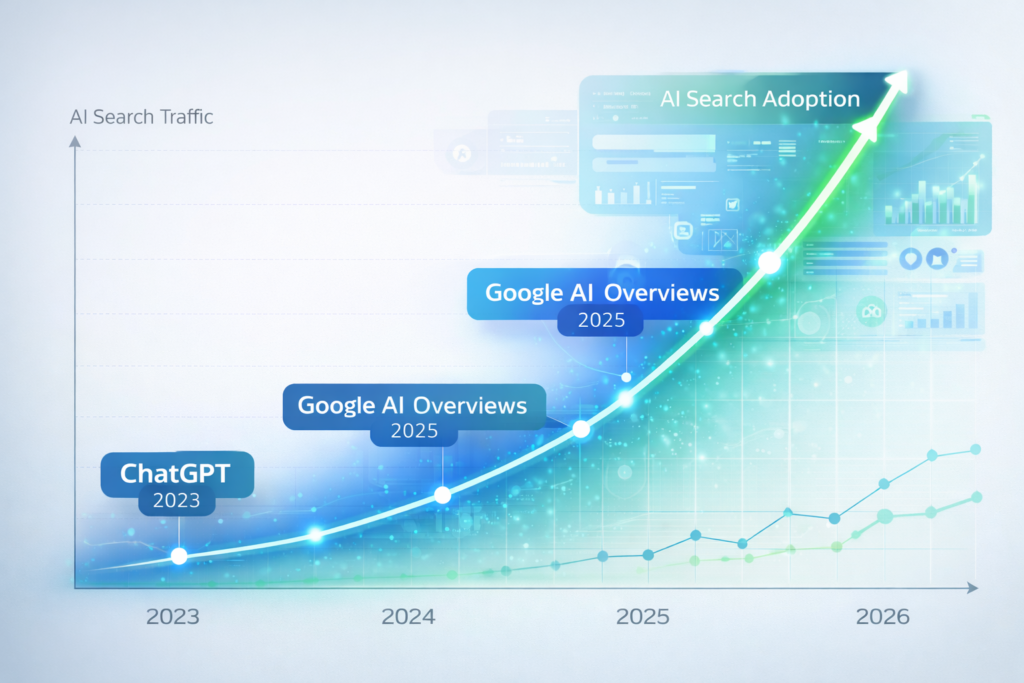
Let’s talk numbers. The shift to AI-driven search is no longer theoretical it’s measurable, trackable, and already eating into traditional organic traffic for thousands of businesses.
The Scale of AI Search in 2026
- ChatGPT processes over 800 million weekly active users and 2.5 billion prompts per day (OpenAI, mid-2025)
- Google’s Gemini app has surpassed 750 million monthly users
- Perplexity has reached 45 million active users and 780 million monthly queries
- Google AI Overviews now appear in at least 16% of all searches higher for commercial and comparison queries
- 60% of all searches now end without a click — known as zero-click searches
📊 Data Point: The click-through rate for position #1 on Google with an AI Overview present has dropped to just 2.6%. Source: Incremys GEO Statistics Report, January 2026
This is the core challenge for any business relying solely on traditional affordable SEO services: you can rank #1 and still lose the click because an AI summary answered the user’s question before they ever scrolled to your result.
The Traffic Opportunity on the Other Side
Here’s what makes GEO so compelling for businesses willing to act early: AI-referred traffic is dramatically higher quality.
📊 Data Point: Visitors arriving from AI chatbots are 4.4x more qualified than visitors from traditional organic search. Source: Incremys GEO Statistics 2026
Fewer people may visit your site — but the ones who do are much further along in their decision-making process. They’ve already asked an AI for recommendations. Your brand was cited. Now they’re visiting to confirm.
According to Semrush’s GEO guide, ChatGPT became the #1 referral source for Tally, a form-builder tool, after implementing GEO principles.
📊 Data Point: The GEO market was $886M in 2024 and is projected to reach $7.3 billion by 2031 a CAGR of 34%. Source: Incremys GEO Market Statistics, January 2026
3. GEO for Small Businesses Pros and Cons
Before you restructure your entire content strategy around GEO, here is an honest, data-backed breakdown of both sides.
✅ Pros
- Higher-quality traffic — AI-referred visitors are 4.4x more qualified (Incremys, 2026)
- First-mover advantage — Only 23% of marketers currently invest in GEO measurement
- Brand authority amplification — Being cited by AI builds massive trust signals
- Compounds with traditional SEO — 99% of AI Overview citations come from the top 10 Google results
- Zero-click visibility — Your brand is seen even when users don’t click
- Proven ROI — GEO techniques improve AI visibility by up to 40% on average (Incremys, 2026)
- Massive e-commerce upside — AI-driven retail traffic grew 4,700% YoY by mid-2025 (MarGen, 2026)
- Competitive gap — Most SMBs haven’t started — early movers capture citation share now
❌ Cons
- Not fully measurable yet — Only 16% of brands systematically track AI search performance
- No direct clicks guaranteed — Zero-click means visibility without guaranteed traffic
- Platform instability — AI systems change citation patterns frequently
- Requires ongoing content investment — Static content becomes stale quickly for AI systems
- Longer time horizon — GEO results can take 3–6 months to appear in AI citations
- E-E-A-T bar is higher — AI favors established, authoritative sources over newer sites
- Smaller sites face headwinds — Top brands dominate a large share of AI citations
- Uneven visibility — 26% of brands have zero AI mentions in some industry snapshots
💡 Bottom Line: GEO is not a silver bullet it’s a strategic investment. The businesses that win are those that treat GEO as a layer on top of solid SEO foundations, not a replacement for them. If you’re already working with an affordable SEO company that understands content strategy, adding GEO is a natural evolution.
4. How AI Systems Actually Choose Which Brands to Cite
This is the question every business owner wants answered: “What does it actually take for ChatGPT or Google to mention my brand?”
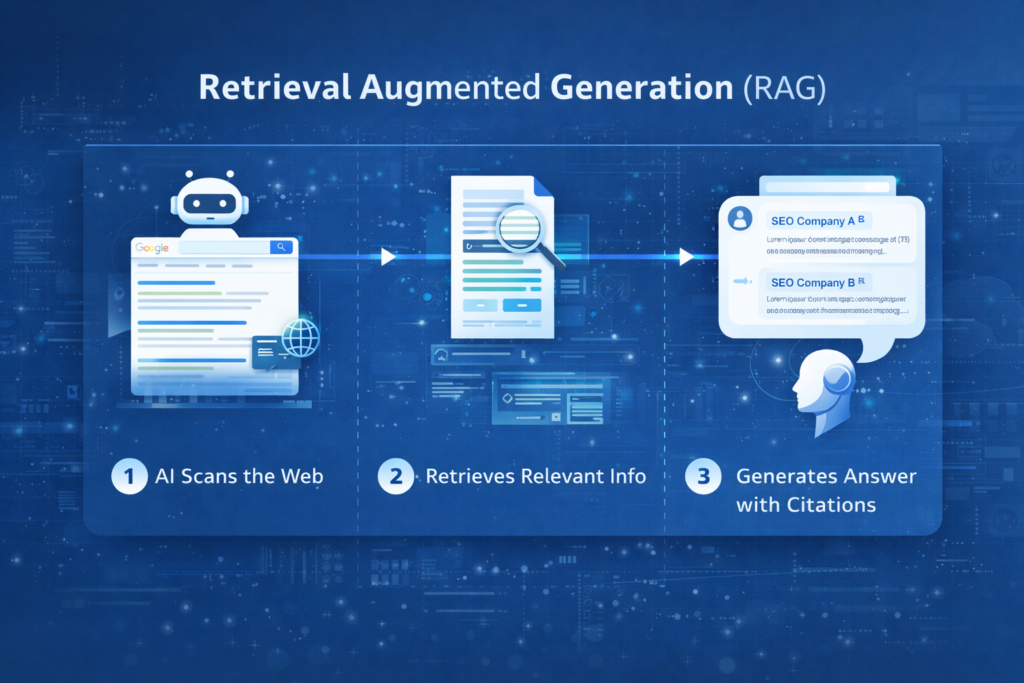
The answer comes down to a technology called Retrieval-Augmented Generation (RAG), which most AI search platforms use. RAG works in two phases: first, the AI retrieves relevant content from across the web. Then, it generates a human-readable response using that retrieved content as context.
For your brand to be included, your content must pass through both stages it must be retrievable, and then it must be deemed trustworthy enough to include in the generated answer.
The 5 Signals AI Uses to Select Sources
- Topical Authority — You must demonstrate consistent, deep expertise across a topic cluster. One good blog post is not enough. AI systems evaluate the full network of content surrounding your brand.
- Structured, Answer-First Content — AI systems favor content that provides a direct, concise answer in the first 40–60 words of a section. This mirrors how featured snippets work.
- Fact Density and Data — Content with verifiable statistics, sourced data, and specific numbers is more likely to be cited. AI systems are trained to prefer precise, citable claims.
- Third-Party Brand Mentions — Reviews on G2, Capterra, or Trustpilot, press coverage, and community discussions on Reddit and LinkedIn all signal to AI that your brand is real and credible.
- Technical Accessibility — AI crawlers must be able to parse your site. Proper schema markup, clean site structure, fast load times, and no crawler-blocking configurations are all critical.
According to Clearscope’s 2026 SEO/AEO Playbook, “What AI models see is not what search engines rank. Optimizing for one no longer guarantees inclusion in the other.” This means your professional SEO company needs to be thinking about both ranking signals and citation signals simultaneously.
📊 Data Point: 87% of ChatGPT citations correspond to the Bing top results. 99% of AI Overview citations come from Google’s organic top 10. Source: Incremys GEO Statistics, January 2026
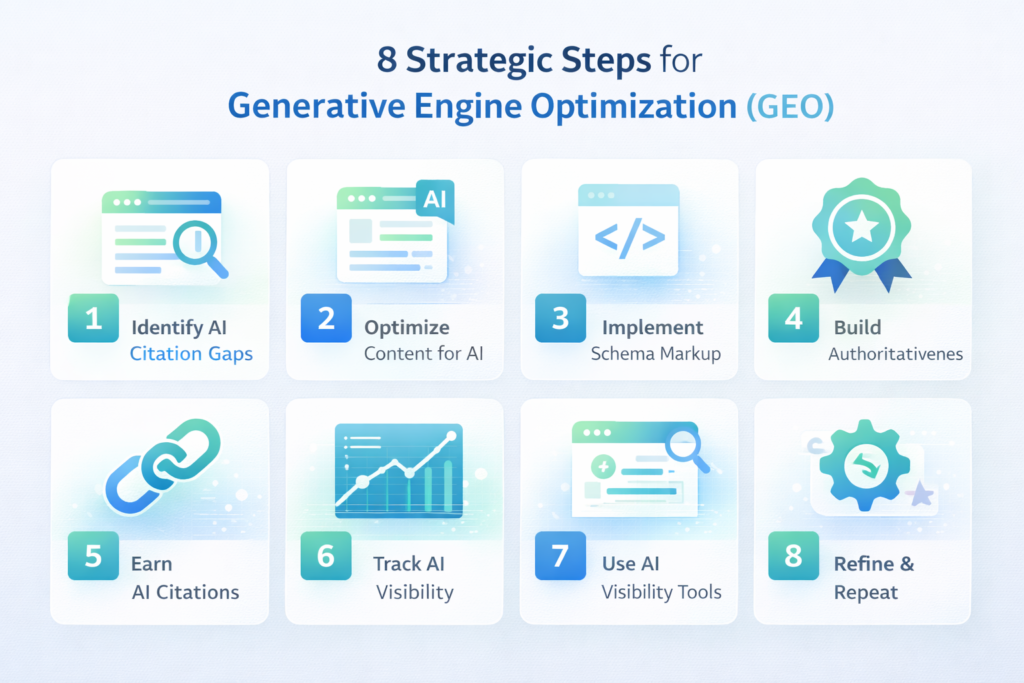
5. The GEO Playbook: 8 Actionable Strategies for AI Visibility
Strategy 1: Build Topical Cluster Content
AI systems don’t evaluate individual pages they evaluate the breadth and depth of your brand’s coverage across a topic. If you publish one article about affordable SEO services but nothing else in that topic area, your authority signal is thin.
Build a cluster: one comprehensive pillar post surrounded by supporting articles targeting sub-topics, questions, and related keywords. Every supporting article links back to the pillar. Every pillar links outward to supporting posts. This is exactly how DigitalBranches.com structures all blog content because topical depth is the signal both Google and AI systems reward.
Strategy 2: Structure Every Section with Answer-First Content
The first 40–60 words of every H2 section should directly answer the question that heading poses. Don’t build to the answer lead with it. This is how AI systems extract content: they read the first available direct answer and cite it.
- Place your direct answer immediately after the heading
- Follow with data, examples, and elaboration
- Use FAQ schema markup for all question-based sections
- Keep answers between 40–60 words for optimal AI extraction
Strategy 3: Publish Original Data
AI systems crave unique, citable information. Generic content that summarizes what everyone else says is rarely cited. Original surveys, proprietary data, case study results, or unique analysis give AI systems something new to reference — and give other publishers a reason to link to you.
According to Search Engine Journal’s GEO analysis, unique data assets have become one of the most powerful differentiators in both off-page SEO and AI visibility strategies.
Strategy 4: Build Brand Mentions Across Trusted Platforms
Reddit, LinkedIn, and YouTube were among the top cited sources by major LLMs in 2025. Your brand needs presence on the platforms AI systems trust:
- Publish on LinkedIn regularly — AI systems actively pull from LinkedIn articles
- Participate authentically in relevant Reddit communities
- Create YouTube content with detailed descriptions and transcripts
- Earn reviews on G2, Capterra, Clutch, or industry-specific platforms
- Get featured in industry publications through digital PR campaigns
Strategy 5: Implement Schema Markup
Schema markup is machine-readable code that tells AI systems exactly what your content is about, who wrote it, and what its key claims are. The most impactful schema types for GEO:
- FAQ Schema — for question-and-answer sections
- Article Schema — with full author details for E-E-A-T
- Organization Schema — confirms your brand’s legitimacy
- Review Schema — surfaces star ratings in AI responses
Strategy 6: Refresh Content Regularly
AI retrieval systems weight recency for time-sensitive queries. An article with a visible “Last Updated: March 2026” tag and fresh statistics outperforms identical content not updated since 2023.
Add a “What Changed in 2026” section to your most important posts. Update statistics quarterly. Treat your cornerstone content as a living document, not a published-and-forgotten asset.
Strategy 7: Build E-E-A-T Signals
E-E-A-T — Experience, Expertise, Authoritativeness, and Trustworthiness directly influences both traditional rankings and AI citation probability. Practical steps:
- Add detailed author bios with credentials, headshots, and LinkedIn links
- Cite authoritative external sources throughout your content
- Build a strong “About Us” and “Team” page with verifiable professional backgrounds
- Earn editorial coverage in recognized publications in your industry
Strategy 8: Track AI Visibility — Not Just Rankings
You cannot improve what you don’t measure. Tools like Semrush’s Enterprise AIO, Writesonic, and Clearscope now monitor brand visibility across ChatGPT, Google AI Mode, and Perplexity.
Start measuring these three KPIs immediately:
- AI Citation Share — how often your brand appears in AI responses for target queries
- Citation Sentiment — whether your brand is mentioned positively or negatively
- Zero-Click Displacement Rate — how much traffic AI Overviews are absorbing from your pages
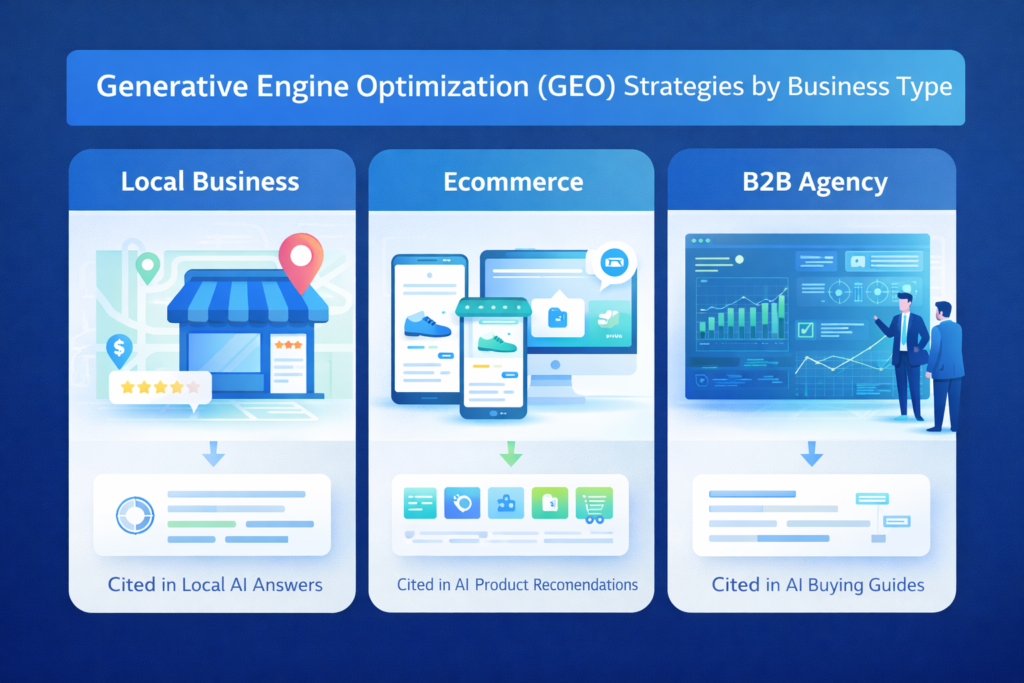
6. GEO Strategy by Business Type
Local Service Businesses
If you’re an HVAC company, law firm, dental practice, or any business where customers search “near me,” your GEO strategy centers on local authority. This means Google Business Profile optimization, consistent NAP citations across directories, earning keyword-rich Google reviews, and creating localized FAQ content that answers the specific questions local customers ask AI tools.
💡 Keyword Opportunity: “seo company near me” (9,900 SV | KD 19) A locally optimized GEO strategy is the fastest path to capturing this intent across both Google Maps and AI-generated local results.
E-Commerce Brands
According to MarGen’s 2026 GEO Guide, AI-driven retail traffic surged 4,700% year-over-year by mid-2025. For e-commerce, GEO means: structured product data, detailed comparison content, FAQ pages for product categories, and aggressive review acquisition across major platforms.
B2B Service Agencies
For agencies offering white label SEO services, professional SEO packages, or website optimization services, GEO means building thought leadership content that AI systems associate with your expertise. Publish original research, case studies with real data, and definitive guides. LinkedIn content is especially powerful for B2B GEO since LinkedIn is one of the top-cited sources by major LLMs.
7. How GEO and Traditional SEO Work Together
One of the most important points to understand: GEO doesn’t replace your existing SEO investment it amplifies it.
According to Incremys GEO research, 99% of AI Overview citations come from the organic top 10. This means your brand needs to rank well in traditional search before AI systems will even consider citing you. SEO is the prerequisite for GEO.
But the reverse is also true: brands implementing GEO see compounding SEO benefits. When AI systems cite your brand, it generates brand search volume. Brand searches signal authority to Google. Google rewards authority with higher rankings. Higher rankings increase AI citation probability. The loop reinforces itself.
📊 Data Point: 63% of companies that have optimized for GEO report a measurable increase in overall digital visibility. GEO techniques improve AI visibility by 40% on average. Source: Incremys GEO Statistics, January 2026
💡 The DigitalBranches.com Approach: Every SEO package we offer now includes GEO-readiness as a standard layer structured content frameworks, FAQ schema implementation, E-E-A-T optimization, and AI citation tracking. Because in 2026, affordable SEO services that ignore GEO are already behind.
Frequently Asked Questions About GEO
What is Generative Engine Optimization (GEO)?
Generative Engine Optimization (GEO) is the practice of optimizing your content and brand presence so that AI platforms like ChatGPT, Google AI Overviews, Perplexity, and Gemini cite and recommend your brand in their generated responses. Unlike traditional SEO which targets ranked link lists, GEO targets inclusion inside AI-generated answers.
Is GEO the same as SEO?
No, but they are closely related. SEO focuses on ranking in traditional search engine results. GEO focuses on being cited in AI-generated responses. However, since 99% of AI Overview citations come from the Google organic top 10, strong SEO remains the foundation that makes GEO possible.
How long does it take to see GEO results?
GEO citation results typically take 3–6 months to become measurable, similar to traditional SEO timelines. Content freshness, topical authority depth, and E-E-A-T signals all influence how quickly AI systems begin citing your brand.
Can small businesses compete in GEO against large brands?
Yes, especially in niche verticals. While large brands dominate broad queries, small businesses with deep topical authority in specific areas can earn AI citations that larger generalist brands miss. Niche expertise, original data, and consistent publishing are the equalizers.
How do I track if my brand is being cited by AI tools?
Use tools like Semrush Enterprise AIO, Writesonic’s AI Search Tracking, or manual prompt testing in ChatGPT and Perplexity. Track AI citation share, citation sentiment, and zero-click displacement rate.
How does GEO relate to affordable SEO services?
GEO is the next evolution of website optimization services. Any affordable SEO company worth hiring in 2026 should already be incorporating GEO principles, structured content, FAQ schema, E-E-A-T optimization, and AI visibility tracking into their standard service offerings.
Conclusion: The Window Is Open — But It Won’t Stay That Way
Generative Engine Optimization is the most significant shift in search visibility since Google introduced the featured snippet. The businesses that act now while most competitors are still figuring out what GEO means will build citation authority that compounds for years.
The data tells a clear story: with 800 million weekly ChatGPT users, 60% zero-click search rates, and AI-referred visitors converting at 4.4x the rate of traditional organic traffic, GEO is no longer optional for any business that depends on being found online.
The good news? If you’re already investing in affordable SEO services and building quality content, you have the foundation. GEO is not starting over it’s evolving what you’re already doing.
At DigitalBranches.com, our SEO packages now include full GEO readiness as a standard feature whether you’re a local service business, an e-commerce brand, or a B2B agency building thought leadership visibility.
🚀 Ready to Get Found on ChatGPT, Perplexity & Google AI?
DigitalBranches.com offers affordable SEO packages that include full GEO optimization structured content strategy, schema markup, E-E-A-T building, and AI citation tracking. 👉 Get Your Free SEO + GEO Audit: www.digitalbranches.com