
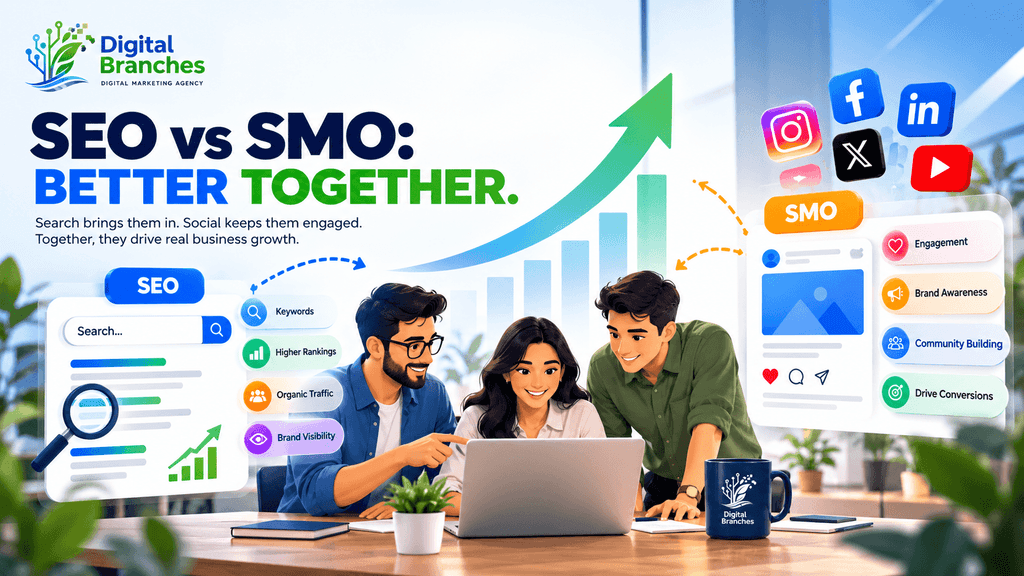
SEO vs SMO in 2026: Which One Does Your Business Actually Need?
Most businesses ask the wrong first question. They ask “SEO vs SMO — which one do we actually need?” when the real question is “which one is quietly losing us customers right now?” SEO and social media optimization aren’t competing strategies — they’re two different levers that move different parts of the funnel, and treating the SEO vs SMO decision as an either/or choice is one of the more expensive mistakes a growing business can make.
This guide breaks down the SEO vs SMO debate properly: what each one actually does, where they overlap, and how to figure out which one deserves your budget first — based on where you are right now, not a generic best practice. According to HubSpot’s State of Marketing research, businesses that align search and social strategy consistently report stronger lead quality than those running the two in isolation.
SEO vs SMO: The Core Difference
Before going further into the SEO vs SMO comparison, it helps to define both in one sentence each: SEO captures demand that already exists in search, while SMO creates demand and awareness before someone ever starts searching. Neither replaces the other — they solve different halves of the same growth problem.
What SEO Actually Does
Search engine optimization gets your website found when someone is already looking for what you sell. Someone types “emergency plumber near me” or “best project management software for agencies,” and SEO determines whether you show up in that moment or your competitor does.
It works on intent that already exists. Nobody searches “emergency plumber near me” for fun — they have a burst pipe. SEO captures demand, it doesn’t create it.
The core components:
- Technical SEO — site speed, crawlability, mobile usability, structured data. If Google can’t crawl and understand your site, nothing else matters.
- On-page SEO — content, keyword targeting, internal linking, title tags, and headers that match what people are actually searching for.
- Off-page SEO — backlinks, brand mentions, and third-party signals that tell search engines your site is trustworthy.
- AI search readiness — increasingly, whether your content gets cited inside AI Overviews and chat-based answers, not just ranked in the traditional ten blue links.
For a deeper technical grounding, Moz’s Beginner’s Guide to SEO is one of the most widely cited free resources in the industry. And if you want the breakdown of what a strong SEO partner actually looks like in 2026, we cover that in detail in our guide to the top SEO companies in the USA and our dedicated best SEO company in the USA resource.
What SMO Actually Does
Social media optimization is a different job entirely. It doesn’t wait for demand — it builds it. SMO is how your brand shows up in someone’s feed before they’ve ever typed a search query, shaping awareness, trust, and recall long before a purchase decision happens.
Where SEO answers a question someone already asked, SMO plants the question in the first place.
The core components:
- Profile and content optimization — consistent branding, optimized bios, and content formatted for how each platform’s algorithm actually distributes reach
- Engagement strategy — building a pattern of interaction that signals to the platform (and to real humans) that your account is worth showing to more people
- Content-to-search handoff — social content that drives branded search volume, which in turn feeds SEO signals like direct traffic and brand mentions
- Community and retention — turning one-time visitors into repeat customers by staying visible after the first interaction
Platforms themselves confirm this is measurable — Sprout Social’s engagement research consistently shows that optimized, consistent posting outperforms sporadic activity by a wide margin on reach and recall. We go deeper on how this works as a standalone service in our breakdown of social media optimization services, including what a properly run SMO program includes month to month.
Where SEO and SMO Actually Overlap
This is the part most agencies gloss over in the SEO vs SMO conversation, because most agencies only sell one of the two.
Social signals don’t directly move rankings the way backlinks do — Google has said this for years. But the indirect relationship is real and well documented:
- Content that performs well socially tends to earn more organic backlinks, because more people see it and more people link to it
- Branded search volume (people searching your company name directly) is fed heavily by social visibility, and branded search is one of the clearest trust signals a site can send
- AI Overviews and AI chat assistants increasingly pull from a wider signal set than traditional search engines did, including how a brand is discussed and cited across the web — social presence contributes to that footprint
- A stronger social presence extends the shelf life of content that SEO already worked to rank, since it keeps getting rediscovered and reshared instead of going stale
Treated separately, SEO and SMO each do half a job. Treated together, each one makes the other’s results compound faster — which is really the honest answer to the SEO vs SMO question: it was never meant to be a choice. Search Engine Journal’s coverage of AI-driven search has repeatedly pointed to this same convergence as one of the defining shifts of 2026. That’s the whole premise behind why we built our SEO and SMO services as one connected engagement instead of two separate retainers with two separate reporting dashboards.
SEO vs SMO: Which One Should You Start With?
There’s no universal answer to the SEO vs SMO question, but there is a reliable way to figure out your own answer. Ask three questions:
1. Does demand for what you sell already exist in search? If people are actively searching for your product or service category, SEO usually wins the priority fight — you’re leaving existing demand on the table every day you’re not visible for it.
2. Is your brand new or unknown? If nobody’s searching for you by name and your category has low search volume, SMO usually needs to come first. You can’t capture search demand that doesn’t exist yet — you have to build it.
3. What’s your sales cycle length? Short sales cycles (ecommerce, local services) tend to lean SEO-first because the path from search to purchase is short. Longer B2B cycles often benefit more from sustained social visibility that keeps you top-of-mind through a multi-month decision process.
Most businesses land somewhere in the middle — which is why running both isn’t a luxury, it’s usually the efficient path, not the expensive one. If budget is the real constraint, look at affordable SMO services that scale with you rather than locking you into an enterprise-sized retainer before you’re ready for one.
How to Evaluate a Combined SEO + SMO Partner
If you decide you need both, don’t just hire two separate vendors and hope they coordinate. A few things worth checking before you sign anything:
- Ask how the two teams communicate internally. If SEO and social sit in different departments with no shared reporting, you’re paying for coordination that isn’t actually happening.
- Ask for their content-to-link pipeline. A real combined strategy should show you how a piece of content moves from social distribution to earned backlinks to ranking improvement — not just two separate content calendars.
- Ask about attribution. A partner worth paying should be able to show you how social-driven brand search correlates with organic performance over time, not just vanity metrics like follower count.
- Ask about AI visibility specifically. In 2026, a partner who can’t explain how they’re optimizing for AI Overviews and AI chat citations is optimizing for a search landscape that’s already partially gone.
Is SEO or SMO better for my business?
Neither is universally “better”, the SEO vs SMO decision depends on whether existing search demand for your product already exists. If people are actively searching for what you sell, start with SEO. If you’re building brand awareness from scratch, start with SMO.
Does social media actually help SEO rankings?
Not directly — social signals like likes and shares aren’t a confirmed direct ranking factor. Indirectly, yes: social visibility drives branded search, earns backlinks through wider content distribution, and extends how long content stays relevant, all of which do influence organic performance over time.
Should a startup focus on SEO or SMO first?
If your product category has real, existing search volume, start with SEO to capture it. If you’re building a new category or brand with little existing search demand, SMO usually needs to come first to create awareness search can later capture.
Is it more expensive to run SEO and SMO together?
Not necessarily. Combined engagements often cost less than running two fully separate retainers with duplicated strategy and reporting overhead, since the content and research can be shared across both channels instead of built twice.
How long before SEO and SMO show results together?
Social visibility can move faster — weeks, not months — but sustainable, compounding results from a combined strategy typically show up in the 4-to-6-month range, with meaningful business impact (leads, revenue) building out to 9–12 months, similar to SEO timelines on their own.
The Bottom Line on SEO vs SMO
The SEO vs SMO debate isn’t really a debate once you see the funnel clearly: they’re two different stages of the same customer journey, one creating demand and the other capturing it. The businesses that treat SEO and SMO as connected tend to outperform the ones running them as separate, uncoordinated efforts.
If you’re still deciding who to work with, our full breakdown of the top SEO companies in the USA and our dedicated page on the best SEO and SMO company in the USA are both good next stops — and if budget is the deciding factor, start with affordable SMO services to see what a combined program looks like at a smaller scale.
Sources referenced: Google Search Central for technical SEO guidance; Search Engine Land for ongoing AI Overview and algorithm coverage; Moz’s Beginner’s Guide to SEO for foundational SEO concepts; Sprout Social for social engagement benchmarks; HubSpot for integrated marketing research; Search Engine Journal for AI search trend coverage.